If a parent lost a job after your FAFSA was filed, you can ask each college’s financial aid office to recalculate your aid based on your current income instead of the older tax year the FAFSA used. This is called a Professional Judgment review (sometimes “special circumstances” or a “financial aid appeal”), and a layoff is one of the clearest cases for it. Below is exactly how to request one.
Can you appeal the FAFSA after losing a job?
Yes. Federal law gives financial aid administrators the authority to adjust the data elements behind your aid on a case-by-case basis when a family’s situation has changed — including a loss of employment. You can’t undo the submitted FAFSA, but you can ask the school to use Professional Judgment to reflect what’s true now. See the U.S. Department of Education’s overview on studentaid.gov and the detailed rules in the Federal Student Aid Handbook (Application and Verification Guide, “special cases”).
One important point: there is no single federal appeal form and no central place to file. Each college’s financial aid office runs its own process, makes its own decision, and that decision is final — it can’t be escalated to the Department of Education. So you’ll request this from each school your student is considering or attending.
Why a job loss qualifies
The FAFSA you filed for the 2026–27 year used your 2024 income (the “prior-prior” tax year). That’s by design — but it means a 2026 layoff isn’t reflected anywhere in your aid calculation. Professional Judgment exists precisely to close that gap: it lets the aid office substitute figures that better represent your current ability to pay, which can lower your Student Aid Index (SAI) and increase need-based aid.
A job loss is among the most recognized “special circumstances,” alongside reduced hours, divorce or separation, the death of a parent, and unusually high out-of-pocket medical costs. What matters is that the change is real, recent, and documented.
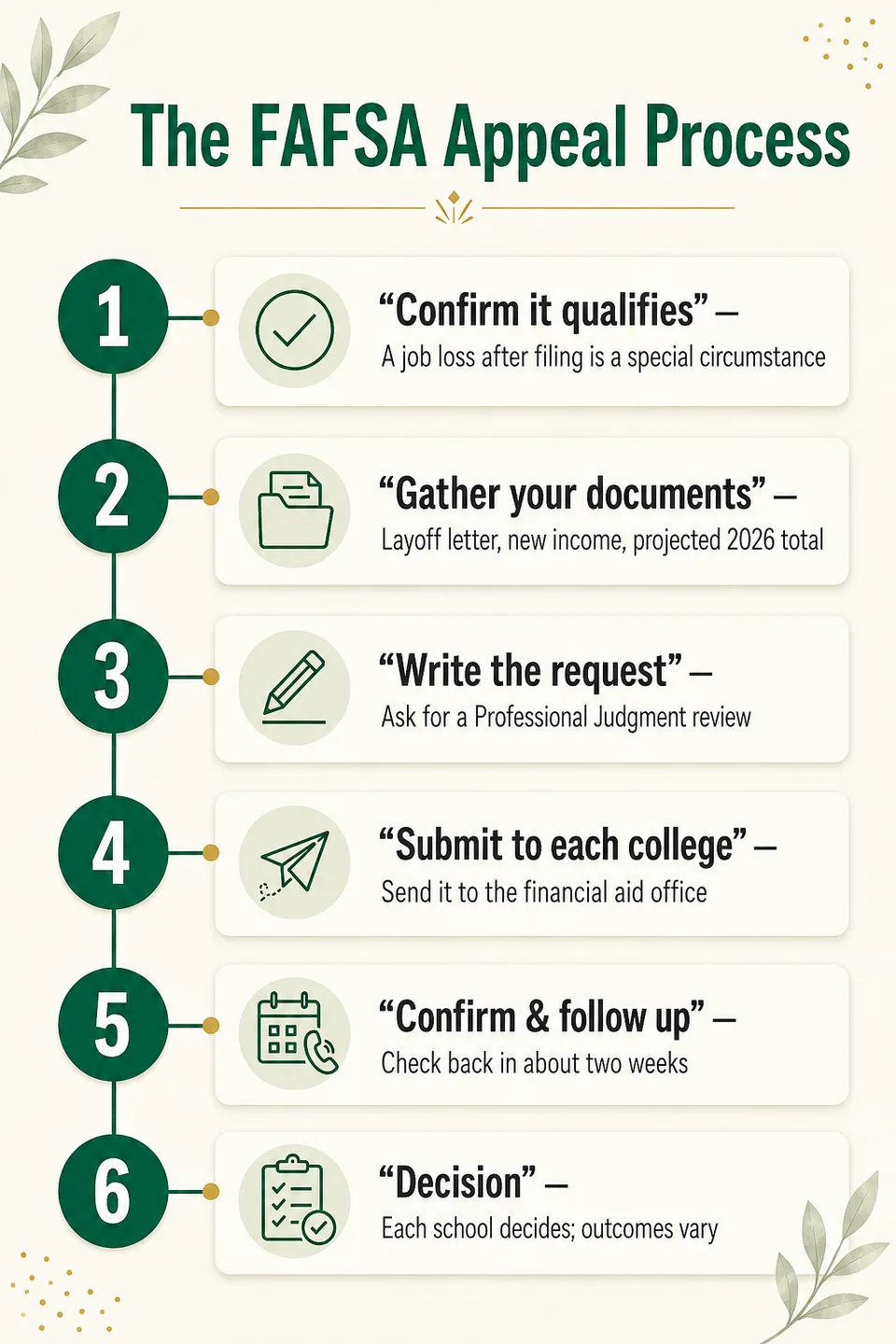
What to gather before you write
Aid officers approve well-documented requests and reject vague ones. Collect:
- Proof of the job loss — a layoff or termination letter, a notice of separation, or a final pay stub showing the end date.
- Evidence of any replacement income — unemployment benefit determination, severance details, or new (lower) pay stubs.
- A realistic estimate of your 2026 income — what the household will actually earn this calendar year given the change.
- Your most recent return for the year already on the FAFSA, so the office can see the before-and-after.
A complete packet gets reviewed; an incomplete one gets set aside. For a scenario-by-scenario list, the documentation guide in this section walks through exactly what each office expects.
What to write
Keep the letter short, factual, and specific. A workable structure:
- State the request plainly — you’re asking for a Professional Judgment review due to a job loss after filing.
- Give the facts — who lost the job, when, and the income before vs. now.
- Point to the attachments — list the documents you’ve enclosed.
- Make the ask concrete — request that they reassess your aid based on current income.
A one-line example of the tone that works:
“Because my 2024 tax return no longer reflects our income, I’m requesting a Professional Judgment review based on our projected 2026 income of $[amount], documented in the attached materials.”
If you’d rather not start from a blank page, our done-for-you templates handle the wording for you.
The number that matters: your current income
The figure that moves a job-loss appeal is a credible projection of your current-year income — not last year’s. Total what the household realistically expects to earn in 2026: any wages to date, unemployment benefits, severance, and a parent’s new job if there is one. Showing that number clearly, with documents that back it up, does more for your case than pages of explanation.
Where and when to submit — and how to follow up
Send your request to each school’s financial aid office (many publish a “special circumstances” or “income appeal” form on their site — use it if it exists). Then:
- Submit as early as possible. Aid is often awarded from limited pools, so earlier requests can have more room to work with.
- Confirm receipt, and note who you spoke with.
- Follow up in about two weeks if you haven’t heard back. Most stalled appeals weren’t denied — they got buried.
What to realistically expect
Be honest with yourself about outcomes. Professional Judgment decisions are made individually by each college and vary widely. Many well-documented job-loss requests result in some increase in aid; adjustments commonly land in the low thousands of dollars per year, though the range is broad and depends entirely on the school and your situation. A full reduction of your SAI to zero is rare and reserved for the most severe losses.
What you can control is the strength and clarity of your case. A complete, well-documented, plainly-written request, submitted early and followed up politely, is the version most likely to succeed. The decision is the school’s; the submission is yours.
This guide is informational and is not legal or financial advice. Professional Judgment decisions are made by individual college financial aid offices and outcomes vary.